

Training modality · 230 items
Standardised patient
Communication and the therapeutic relationship.
Communication is the procedure.
There is no manikin at the centre here: there is a person trained to play a case reproducibly, and the student has to talk to them. Breaking bad news, obtaining consent, taking a difficult history, handling a relative in conflict.
What you buy in this modality is not the patient — it is the infrastructure that makes the session assessable: the room, the audio-video system, the rubrics and the make-up materials. Without recording and without a rubric, the session is a pleasant conversation from which nobody learns anything measurable.
When this is the right modality
Choosing the right modality saves more money than negotiating the price of the equipment.
Choose it when…
- Communication skills are being assessed in a structured way, as in an OSCE.
- The same case has to be repeated identically for several students.
- The objective includes attitude and rapport, not just clinical content.
- The student should be able to watch themselves afterwards.
It isn't the right one if…
- The objective is manual dexterity. See Task trainer →
- There are no trained actors and no budget to train them. See Digital tools →
- There is no recording and assessment system.
How it's used in the classroom
What you need to know before sizing the classroom.
- Ratio
- 1 actor per station, 1 student at a time
- Session
- 8–15 minutes per station
- Instructor
- Assessor with a rubric, in person or remote
- Recurring cost
- Low in materials, high in people
How to budget for it properly
Here the investment is in people rather than equipment: training the actors and keeping them available. And that works in your favour, because an OSCE circuit pays for itself through the number of students who pass through it: sizing the stations well multiplies what each actor delivers.
Who uses it
Specialties that turn to this modality most often.
Common procedures
Equipment in this modality
230 references in the catalogue.
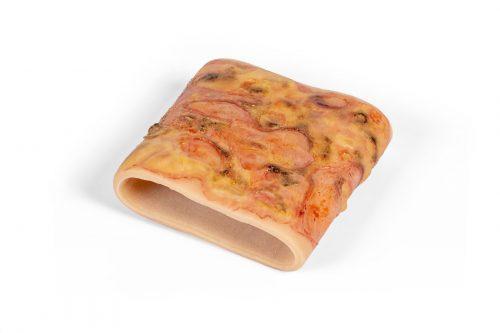
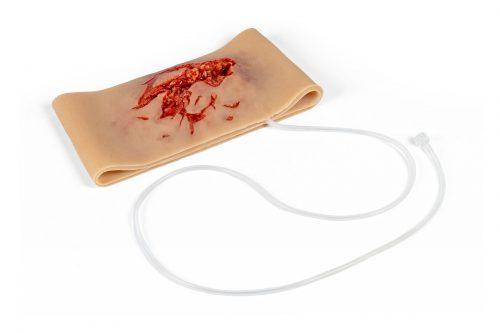
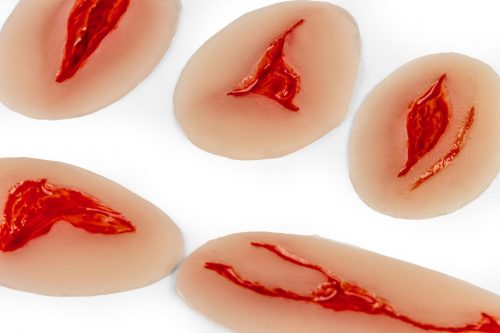
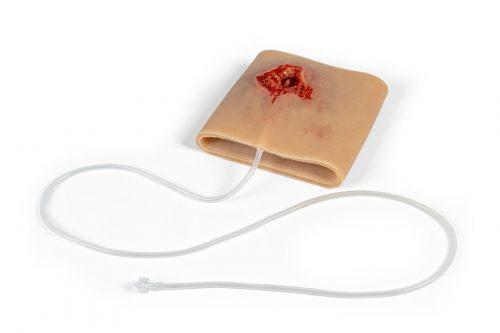
Wound Simulation Sleeve: Arm Gunshot Wound with Bleeding Function
Reference 14387


The six modalities
Task trainer
Specific procedural skill.
1,866 items →Anatomical model
Understanding structure and function.
867 items →Patient and equipment simulators
Technical and non-technical skills, and equipment handling.
339 items →Ultra realism
High-impact critical scenarios.
414 items →Standardised patient
Communication and the therapeutic relationship.
You're viewing this oneDigital tools
Clinical reasoning and decision-making.
11 items →