

Reference 14389 · Standardised patient
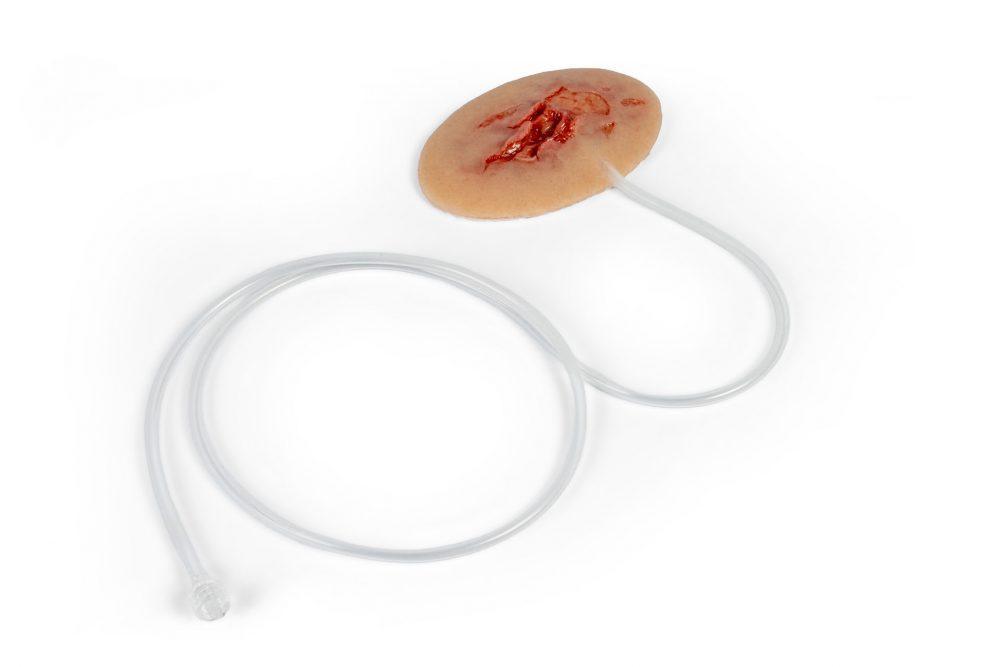
Wound moulage axillary injury with bleeding function
- Standardised patient
- Emergencies
- Main product
- Medicine
Moulage simulating a severe injury in the axillary region, with integrated blood supply line and Velcro attachment.
Price on request
Available in Spain, Portugal and Andorra · delivery time given in the proposal
Downloadable data sheet — features, specifications and delivery time, in PDF.
Need a technical report? Ask us for it and we'll send it within 24 h →
Description
What this equipment is and what it's designed for.
The Axillary Injury Wound Moulage was developed for professional use in tactical medicine, emergency medical training, military medical training and emergency medical services. It provides a realistic simulation of a severe injury to the axillary region and is suitable for highly practical training scenarios.
The model depicts a laceration or shrapnel injury,, such as those caused by an accident or grenade shrapnel. Its detailed design and authentic surface texture give a particularly realistic injury presentation and support effective training under conditions close to real operations.
The moulage can be connected to an external source of artificial blood via the integrated blood supply line. This allows realistic, controlled bleeding to be simulated, enabling practical training in haemostasis, wound care and tactical casualty care.
Made from a soft specialty material, the moulage has a lifelike appearance and a natural feel. Inside, fabric reinforcement provides high tear resistance and durability, so the model keeps its shape and function even with frequent use.
It is secured with a separate Velcro fastening system. A Velcro strip integrated into the back of the model allows quick and secure attachment to training manikins or actors in the upper body area. The model can therefore be used flexibly in a wide variety of training and operational scenarios.
Product features:
- Realistic laceration or shrapnel wound in the armpit
- Suitable for military, emergency medical services and medical training
- Integrated blood flow tube for simulating heavy bleeding
- Can be connected to an external artificial blood source
- Soft, specialised material with a natural, skin-like feel
- Internal fabric reinforcement for high durability and a long service life
- Velcro strip on the back for attachment to the separate Velcro retention system
- Quick attachment to training manikins or actors in the upper body area
- Reusable and easy to clean
The model is suitable for realistic training in Tactical Combat Casualty Care (TCCC), Prehospital Trauma Life Support (PHTLS), emergency medical services, disaster response, law enforcement, the armed forces and simulation training in emergency medicine.
What you learn
Standardised patient modality. The competencies this equipment trains, in the language of the training plan.
- Control junctional haemorrhage in the axilla
- Pack and compress an axillary wound
- Apply tactical casualty care (TCCC)
Related procedures: Trauma · Wound care
Cases and pathologies
The clinical scenarios that can be simulated with this equipment.
- Junctional haemorrhage of the axilla
- Laceration or shrapnel wound
Features and what's included
What the equipment does and what comes in the box, as described by the manufacturer.
Features
- Realistic laceration or shrapnel wound in the armpit
- Integrated blood supply line for controlled bleeding
- Velcro strip on the back for the separate fastening system
- Soft material with internal fabric reinforcement, reusable and easy to clean
Services for this equipment
Services matter: the equipment gets commissioned, the staff know how to use it and maintenance is settled before you start. Include them in your budget and avoid having to raise a second purchase.
- Preventive maintenance We'll let you know when it's due
Documentation
You can download it now or we'll send it on request.
Other related equipment
They train the same technique. Each one approaches it in its own way: none of them replaces this one.


Is this equipment going into a new centre?
If you're equipping a classroom or a whole centre, starting from the shopping list works out expensive. Start from the needs assessment.