

Reference 12928 · Task trainer
Hemorrhage Control Leg Trainer, Dark Skin
- Task trainer
- Emergencies
- Main product
- Medicine
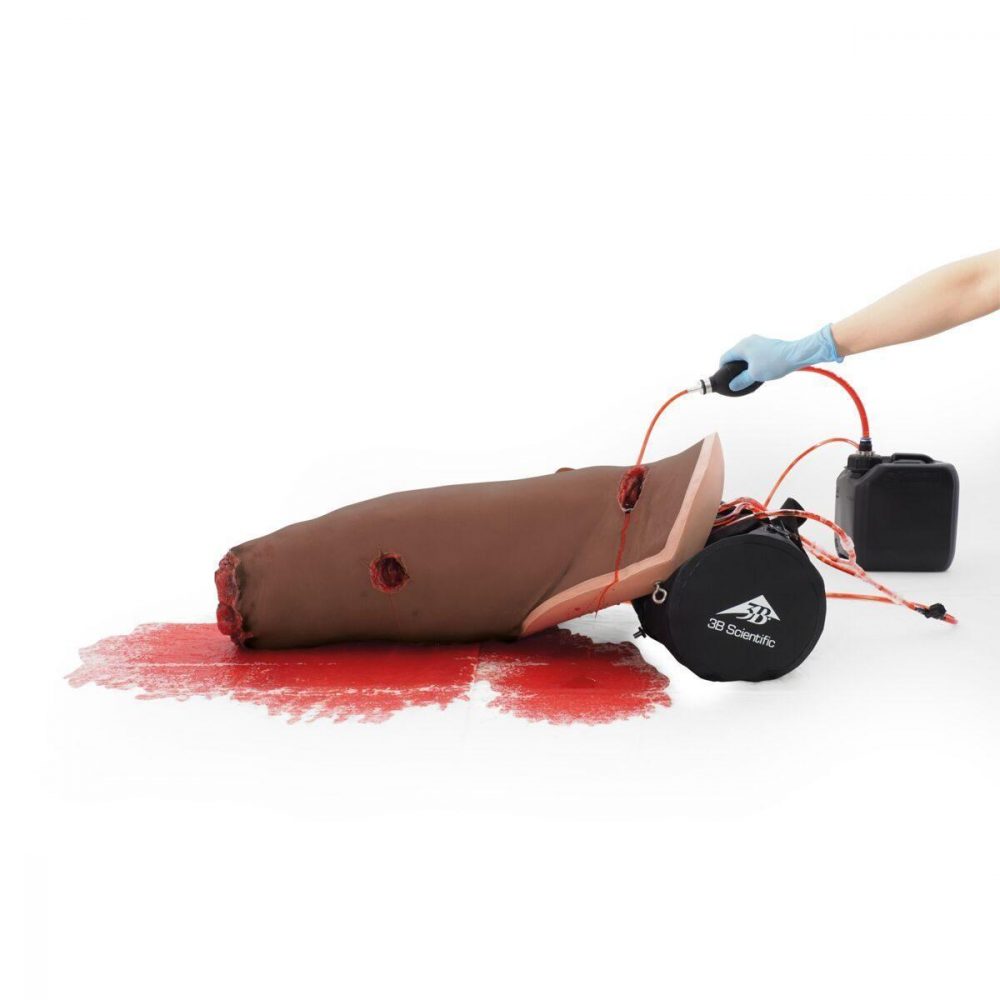
The P103 is a medical skill trainer for hemorrhage control on the lower extremity with an extremely realistic wound and bleeding simulation. It is the ideal tool to improve pre-hospital patient care training with instructional and hands-on training of hemorrhage control with wound packing and tourniquet application.
Price on request
Available in Spain, Portugal and Andorra · delivery time given in the proposal
Downloadable data sheet — features, specifications and delivery time, in PDF.
Need a technical report? Ask us for it and we'll send it within 24 h →
Description
What this equipment is and what it's designed for.
The P103 is a medical skill trainer for hemorrhage control on the lower extremity with an extremely realistic wound and bleeding simulation. It is the ideal tool to improve pre-hospital patient care training with instructional and hands-on training of hemorrhage control with wound packing and tourniquet application. This simulator is especially suitable for Tactical Combat Casualty Care (TCCC) and Civilian Casualty Care training.
The Hemorrhage Control Leg Trainer P103 is an affordable and simple solution for realistic training of bleeding control and management of traumatic injuries on the thigh. Trainees will gain confidence in managing difficult bleeding using tourniquets, wound packing and amputation management skills. The leg trainer P103 is equipped with three different wound patterns:
- Deep laceration (around 4 cm deep) in the groin area
- Gunshot wound through and through (GSW) with entry and exit wound on the upper thigh
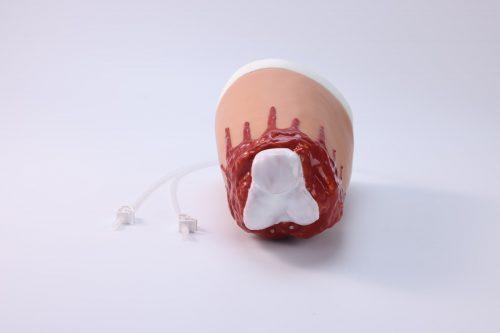
- Amputation in the knee region
A manual blood pump system supplies artificial blood to each wound individually or to any two of them in combination or to three wounds all together. Various scenarios of venous or arterial pulsatile blood hemorrhage can be simulated easily and realistically. The trainee will get a direct visual feedback (stop of bleeding by mechanical occlusion) once the application of the chosen hemorrhage control technique is successful.
The following hemorrhage control procedures can be trained with this simulator:
Limb tourniquet application:
Tourniquets can be placed either “high and tight” at the proximal end of the extremity or 5-8 cm above the wounds. If the tourniquet is applied correctly, the bleeding stops automatically by mechanical occlusion of the blood vessels. Dual tourniquet application is also possible to be trained.
Wound packing:
A deep lying lacerated tube can be palpated manually at the injured blood vessel. The junctional and the gunshot wound can be packed with gauze.
Hemostatic device application:
The gunshot wounds are compatible for an application of the XSTAT® hemostatic device
Stump / Large area wound dressing
Drop knee technique:
This technique is applicable in the scenarios which exclude a junctional wound. A wound cover is supplied for this purpose in the delivery content.
Technical features of the P103 trainer for Hemorrhage Control at the leg:
- The trainer simulates a leg of an adult male with an amputation in the knee region with realistic outer anatomy
- The skin is made of high quality SKINlike™ sturdy silicone to simulate human skin and tissue haptics
- Features bony landmarks and palpable damaged vessel
- Direct feedback: the bleeding will stop (mechanical occlusion of blood vessels) when tourniquet has been correctly applied (placement and closing)
- The application of the tourniquet can be made “high and tight” or 5- 8 cm (2”-3”) above the wound
- Each wound can be hidden with a dedicated cover to offer modular injury scenarios
- Each wound can bleed independently
- Designed for field use: sturdy construction, requires no batteries or external power
- Easy to clean and to transport in carrying bag (included)
- Realistic low-cost simulator for repetitive training
Bleeding system:
- Secure blood reservoir (2 liters) with manual blood pump system simulating venous or arterial pulsatile blood hemorrhage
- No back flow of the blood to the reservoir during wound packing so the simulation will be uninterrupted
- Contains 250 ml of artificial blood concentrate for the preparation of 2 liters of blood
Delivery content:
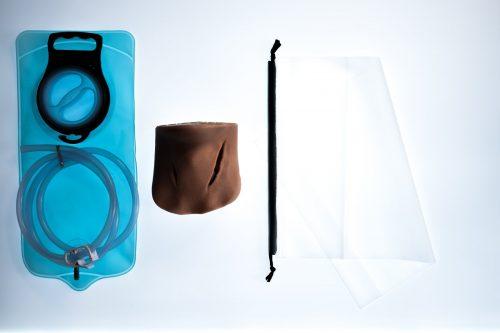
- Trauma leg with 3 different traumatic wounds, choice of light or dark skin
- 2 wound covers
- Manual blood pump system
- Carrying bag
- Sand bag
- Blood reservoir for 2 liters
- Concentrate of artificial blood 250 ml
Please note: tourniquets are not included in the delivery scope.
Available in light or dark skin tone.
What you learn
Task trainer modality. The competencies this equipment trains, in the language of the training plan.
- Application of a high and tight tourniquet at the proximal end of the limb
- Application of a tourniquet 5-8 cm above the wound
- Placement of a double tourniquet
- Wound packing with gauze
- Palpation of the injured blood vessel inside the wound
- Application of a haemostatic device to gunshot wounds
- Dressing of large wounds and of amputation stumps
- Knee-drop technique for direct compression
- Differentiation between pulsatile arterial bleeding and venous bleeding
- Verification of bleeding control through visual feedback
Related procedures: Bleeding control and tourniquet · Trauma · Wound care
Cases and pathologies
The clinical scenarios that can be simulated with this equipment.
- Deep laceration in the genital area, with approximately 4 cm of penetration
- Gunshot wound with entry and exit holes in the upper thigh
- Traumatic amputation at knee level
- Pulsatile arterial haemorrhage of the lower limb
- Venous haemorrhage of the lower limb
- Tactical Combat Casualty Care (TCCC) and civilian casualty scenarios
Features and what's included
What the equipment does and what comes in the box, as described by the manufacturer.
Features
GENERAL:- Simulates the leg of an adult male amputated at knee level, with highly realistic external anatomy
- High-quality hard-wearing SKINlike silicone skin
- Palpable bony landmarks and blood vessels
- Direct feedback: bleeding stops by mechanical occlusion when the tourniquet is applied correctly
- Each wound can be concealed with a specific cover to create modular scenarios
- Each wound can bleed separately
- Designed for field use: no batteries or external power supply required
- Easy to clean and to move in the carry bag
- Safe 2-litre blood reservoir
- Manual blood pumping system that simulates pulsatile arterial or venous haemorrhage
- Independent or simultaneous bleeding from the three wounds
- No backflow of blood into the reservoir during wound packing
- Includes 250 ml of artificial blood concentrate to make up 2 litres
Includes
- 1 Trauma leg with 3 different traumatic wounds
- 2 Wound covers
- 1 Manual blood pumping system
- 1 Carry bag
- 1 Sandbag
- 1 2-litre blood reservoir
- 1 Artificial blood concentrate (250 ml)
Note: tourniquets are not included.
Consumables and spare parts
What this equipment will need next year.
-
Artificial Blood Concentrate (set of 10) Set of 10 artificial blood concentrate bottle (10 x 250 ml)12761
-
Blood Powder Water-soluble blood powder enables to create blood of realistic consistency and feel12993
Services for this equipment
Services matter: the equipment gets commissioned, the staff know how to use it and maintenance is settled before you start. Include them in your budget and avoid having to raise a second purchase.
- Preventive maintenance We'll let you know when it's due
Documentation
You can download it now or we'll send it on request.
Other related equipment
They train the same technique. Each one approaches it in its own way: none of them replaces this one.
-
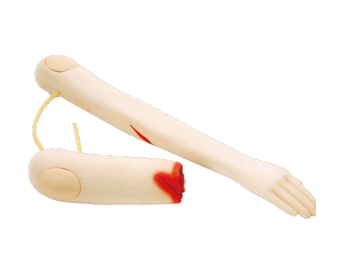 Amputated and Trauma Bleeding Arm
See details →
-
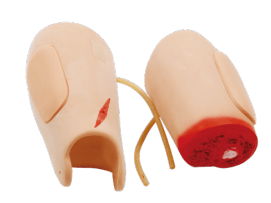 Amputated and Trauma Bleeding Leg
See details →
-
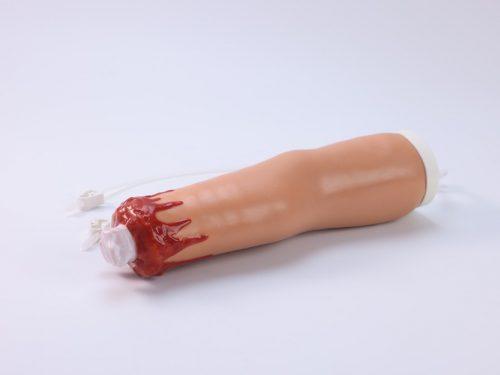 Amputation and Trauma Bleeding Arm
See details →
-
 Amputation and Trauma Bleeding Leg
See details →
-
 Bleeding Neck Task Trainer - essential range - dark skin
See details →
-
 Control the Bleed Kit - light skin
See details →
Is this equipment going into a new centre?
If you're equipping a classroom or a whole centre, starting from the shopping list works out expensive. Start from the needs assessment.