
Reference 04012 · Anatomical model
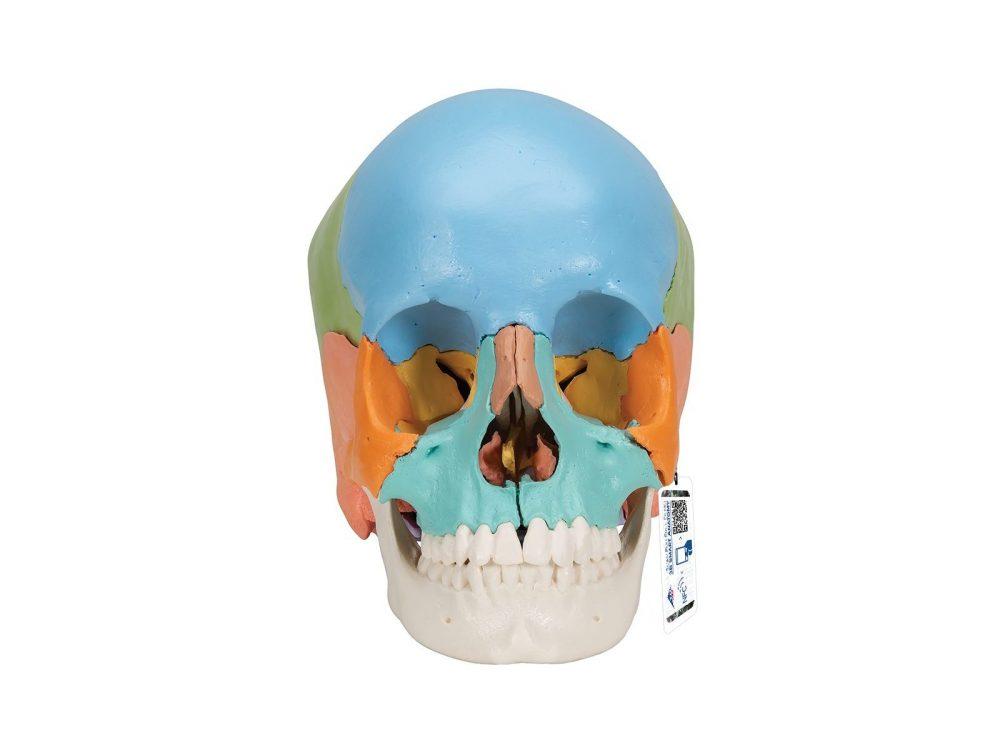
Dismountable coloured skull model, Life size - 22 Parts
- Anatomical model
- Anatomy
- Main product
- Medicine
This Beauchene human skull model is a great tool for teaching and learning the complex anatomy of the human skull. The human skull consists of many individual bones that gradually grow together as the development proceeds.
Price on request
Available in Spain, Portugal and Andorra · delivery time given in the proposal
Downloadable data sheet — features, specifications and delivery time, in PDF.
Need a technical report? Ask us for it and we'll send it within 24 h →
Description
What this equipment is and what it's designed for.
This Beauchene human skull model is a great tool for teaching and learning the complex anatomy of the human skull. The human skull consists of many individual bones that gradually grow together as the development proceeds. The best selling Beauchene Adult Human Skull is a natural cast of a human beauchene skull and makes the complex anatomical structure of the skull easy to understand, since it can be disassembled into its 22 individual bones.
In this didactic version all the bones/bone pairs are colored to make identification easier. The individual bones can be reassembled by means of inconspicuous, stable connectors attached at the slightly simplified skull sutures.
The different bones are attached together with a clever internal pin system which does not affect the natural anatomy. Due to the large number of bones (22) the pin system offers the advantage of being more stable compared to magnet connections.
The skull consists of the following individual bones:
- Parietal bone (left and right)
- Occipital bone
- Frontal bone
- Temporal bone (left and right)
- Sphenoid bone
- Ethmoid bone
- Vomer bone
- Zygomatic bone (left and right)
- Upper jaw (maxilla) with teeth (left and right)
- Palatine bone (left and right)
- Nasal concha (left and right)
- Lacrimal bone (left and right)
- Nasal bone (left and right)
- Lower jaw (mandible) with teeth
What you learn
Anatomical model modality. The competencies this equipment trains, in the language of the training plan.
- Identification of the bones that make up the skull
- Assembly and disassembly of the skull
- Recognition of the cranial sutures
- Differentiation of the paired bones by means of the colour code
- Study of the spatial relationship between the cranial structures
Cases and pathologies
The clinical scenarios that can be simulated with this equipment.
- Skull fractures and fractures of the skull base
- Course of the cranial nerves through the foramina of the skull base
- Sinusitis according to the paranasal sinus affected
- Facial trauma and fractures of the maxillary complex
Features and what's included
What the equipment does and what comes in the box, as described by the manufacturer.
Features
GENERAL:- Made of durable, non-deformable plastic
- Made up of 22 bones, easy to assemble and disassemble
- Internal fastening system, stable and barely visible, which does not affect the natural anatomy
- Serrated suture edges, reflecting the degree of fusion of a real skull
- Bones represented in 9 different colours; the paired bone plates share the same colour
- Precision moulded from a disassembled human skull of European origin
- Parietal bone (left and right)
- Occipital bone
- Frontal bone
- Temporal bone (left and right)
- Sphenoid bone
- Ethmoid bone
- Vomer
- Zygomatic bone (left and right)
- Maxilla with teeth (left and right)
- Palatine bone (left and right)
- Nasal concha (left and right)
- Lacrimal bone (left and right)
- Nasal bone (left and right)
- Mandible with teeth
Services for this equipment
Services matter: the equipment gets commissioned, the staff know how to use it and maintenance is settled before you start. Include them in your budget and avoid having to raise a second purchase.
- Preventive maintenance We'll let you know when it's due
Documentation
You can download it now or we'll send it on request.
Other related equipment
They share a specialty with this one. They train different things: none of them replaces it.
Is this equipment going into a new centre?
If you're equipping a classroom or a whole centre, starting from the shopping list works out expensive. Start from the needs assessment.